-01.png)
You Can’t Stream This: Why Choral Music Is Stronger in the Room

If you have ever listened to a choral recording and thought, That’s beautiful, and then attended a live concert and thought, Oh… this is different, you are not imagining things.
Choral music genuinely affects people more powerfully in person. Not because recordings are bad, but because they can never fully capture what is actually happening when voices share the same space as listeners.
Here is why choral music hits harder live than it ever can through speakers.
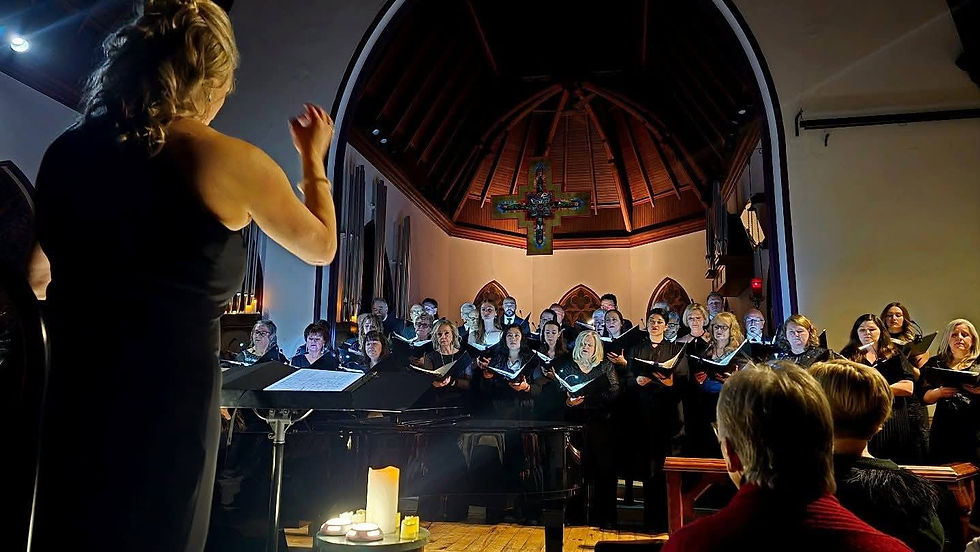
You Are Hearing More Than Sound
When a choir sings live, you are not just hearing notes. You are hearing air move, bodies breathe, and sound waves interact with the room.
Every singer produces overtones, frequencies above the main pitch. When dozens of voices sing together, those overtones blend and reinforce each other. In a good acoustic space, they do not simply reach your ears. They fill the room.
Recordings flatten this experience. Microphones choose what to capture. Speakers decide what survives. Live sound surrounds you, reflects off walls, and reaches you from multiple directions at once.
That is why people often describe live choral music as something they feel as much as hear.
Your Brain Is More Engaged Than You Realize
When listening to a recording, your brain often treats the music as background. It is polished, predictable, and contained.
In a live SATB (soprano, alto, tenor, bass) choir, your brain is working in real time. It tracks multiple vocal lines at once, blends them together, and shifts attention between sections. Sopranos carry one idea. Altos colour another. Tenors and basses ground the sound.
This constant, subtle processing creates engagement. You are not passively consuming music. You are participating in it as a listener.
That mental involvement is one reason live concerts feel immersive, even when the music is unfamiliar.
Breath Changes Everything
One of the most overlooked elements of choral music is shared breath.
In a live performance, phrasing is shaped by how singers inhale and release together. You can sense the preparation before a phrase and the collective exhale that follows. Quiet moments become charged. Entrances feel intentional. Silences carry weight.
Recordings often hide this. Edits remove breaths. Compression smooths the natural rise and fall of sound. What remains is clean, but less human.
Live, the breath is still there, and your body responds to it instinctively.
Dynamics Are Physical - Not Just Audible
There is a difference between something being loud and something being powerful.
In a concert hall, a choir singing softly can command attention in a way no speaker system can reproduce. The quiet feels fragile. The room seems to lean in. When the sound grows, it does not simply get louder. It expands.
Recordings struggle with this range. Volume knobs do not translate emotional scale. Live dynamics do.
This is why the moments people remember most clearly after a concert are often the quiet ones.
You Are Witnessing Something That Can Go Wrong
A live choral performance is not a fixed object. It is an event.
Every entrance, every cutoff, every blend is happening once, in that moment, with no undo button. The singers are listening, adjusting, and trusting one another in real time.
Audiences sense this, even if they cannot explain it. There is a subtle tension that comes from knowing the music is alive and slightly unpredictable. That risk creates focus, both on stage and in the seats.
Recordings remove risk. Concerts restore it, and with it, attention.

The Room Becomes Part of the Music
Choral music is written with space in mind. Composers expect sound to resonate, decay, and return. Each venue shapes the music differently.
Live, the room becomes an instrument. Certain harmonies bloom. Certain consonants sparkle. Certain chords hang in the air longer than expected.
No two performances are ever identical, even with the same choir and the same program. That uniqueness is part of what makes live concerts special.
Shared Experience Amplifies Emotion
There is also something simple and deeply human at work.
Listening to choral music in a room full of other people changes how it lands. You notice stillness. You feel collective attention. Applause carries relief and appreciation.
Emotion becomes communal. That shared response amplifies meaning in a way solitary listening never can.
Why This Matters
You do not need musical training to appreciate any of this. You do not need to understand harmony or know what SATB means.
You only need to be present.
Recordings are valuable. They introduce us to music and preserve performances. But they are invitations, not replacements.
The full experience happens in the room, where sound, space, breath, and people meet.
That is where choral music is strongest, and where it was always meant to be heard.


Comments